
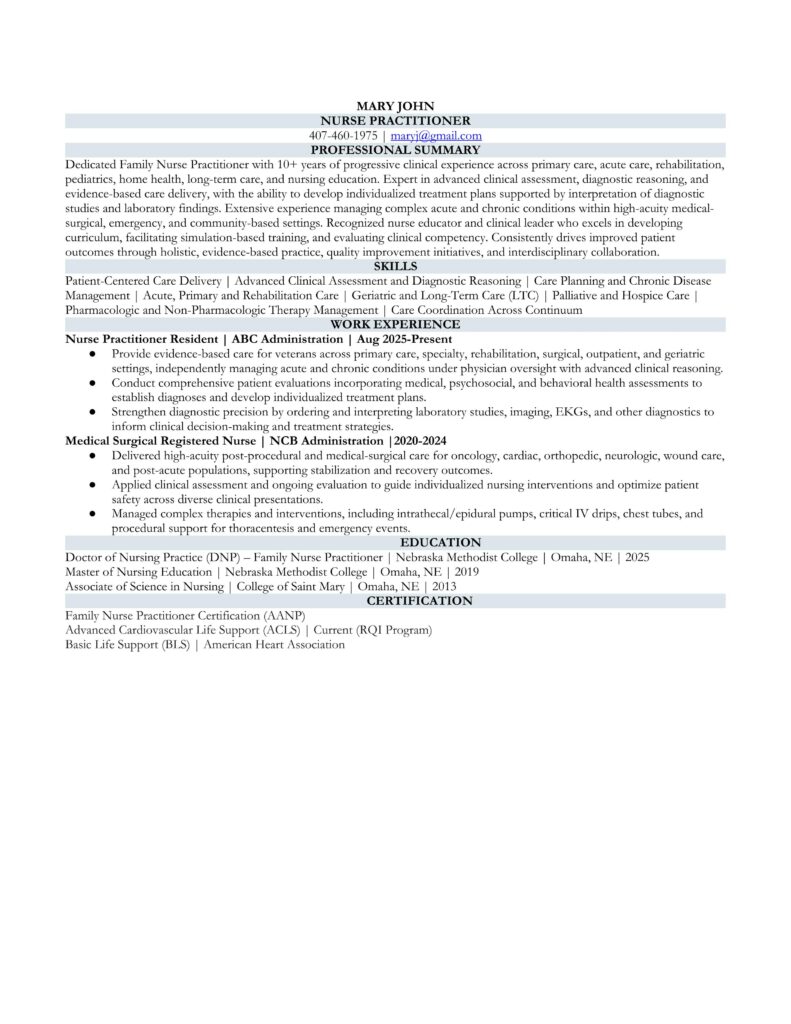
Your nursing resume must show more than where you worked and which duties you performed. It should help a recruiter understand your clinical specialty, patient population, care environment, credentials, level of responsibility, and contribution to safer, more efficient, and more compassionate care.
These nursing resume examples are designed to help you clearly present your value. Whether you are applying for your first bedside position, moving into a new specialty, pursuing advanced practice, or targeting an executive nursing role, you need a resume that reflects the expectations of the specific job.
Use this guide to compare summaries, skills, keywords, accomplishments, and certifications across major nursing specialties. Then tailor the language to your experience, employer requirements, and career goals.
What Should a Nursing Resume Include?
A strong nursing resume should include your professional title and credentials, contact information, a targeted summary, active licenses, relevant certifications, clinical skills, professional experience, measurable accomplishments, education, and specialty-specific keywords.
The strongest nursing resume examples make five details easy to find:
- Your license and credentials
- Your specialty and patient population
- Your clinical setting and level of acuity
- Your strongest nursing capabilities
- The outcomes, improvements, or leadership contributions you delivered
Licensing, certification, and scope-of-practice requirements can vary by location, employer, and specialty. Confirm the exact requirements listed in the vacancy before submitting your application.
How to Use These Examples
Do not copy an example word for word. Your resume should reflect your actual scope, credentials, unit, patient population, procedures, technology, and outcomes.
Review several nurse resume examples to identify the structure and emphasis that align with your specialty. Then replace the example language with evidence from your career.
Each specialty section includes:
- Recommended skills
- Recommended keywords
- Accomplishment examples
- Relevant certifications
Nursing Resume Example Comparison Table
| Specialty | Main Resume Focus | Useful Evidence | Common Credentials |
| Registered Nurse | Patient care, coordination, education, and safety | Patient load, satisfaction, quality, documentation | RN license, BLS, ACLS |
| New Graduate Nurse | Clinical rotations, readiness, and transferable strengths | Clinical hours, capstone, projects, preceptor feedback | RN license or NCLEX status, BLS |
| ICU Nurse | Critical care, monitoring, and rapid intervention | Acuity, ventilators, drips, emergency response | CCRN, ACLS, BLS |
| Emergency Room Nurse | Triage, stabilization, and fast-paced decision-making | Volume, wait time, trauma level, response | CEN, ACLS, PALS, TNCC |
| Pediatric Nurse | Age-appropriate care and family education | Age groups, diagnoses, satisfaction, education | PALS, BLS, CPN |
| Operating Room Nurse | Perioperative safety, sterile technique, and workflow | Cases, specialties, turnover time, compliance | CNOR, BLS, ACLS |
| Nurse Practitioner | Assessment, diagnosis, treatment, and continuity | Visits, outcomes, access, quality measures | APRN license and board certification |
| Nurse Manager | Unit leadership, quality, staffing, and budgets | Team size, turnover, quality, labor cost | RN license, specialty or leadership credentials |
| Chief Nursing Officer | Nursing strategy, quality, workforce, and governance | Enterprise scope, outcomes, cost, retention | RN license, NEA-BC or equivalent |
Specialty Resume Examples for Nurses
1. Registered Nurse Resume Example
A general RN resume should balance clinical knowledge, patient care, interdisciplinary coordination, documentation, education, and safety.
Recommended Skills
Patient assessment, care planning, medication administration, electronic health records, patient education, discharge planning, infection prevention, wound care, interdisciplinary collaboration, and clinical documentation
Recommended Keywords
Registered Nurse, patient-centered care, nursing assessment, care coordination, medication administration, patient education, quality improvement, clinical documentation, discharge planning, and evidence-based practice
Accomplishment Examples
- Delivered comprehensive nursing care for five to six adult patients per shift while maintaining accurate assessments, medication records, and care plans.
- Improved discharge-readiness documentation by introducing a standardized patient-education checklist.
- Collaborated with physicians, pharmacists, therapists, and case managers to coordinate complex treatment and transition plans.
- Recognized early changes in patient condition and initiated timely escalation according to clinical protocols.
Relevant Certifications
Active RN license, Basic Life Support, Advanced Cardiovascular Life Support, specialty certification when relevant, and facility-required training
When reviewing registered nurse resume examples, look for clear evidence of patient complexity, teamwork, safety, and measurable contributions rather than a long list of routine duties.
2. New Graduate Nurse Resume Example
As a new graduate, you may not have years of paid nursing experience, but you still have clinical rotations, education, projects, simulations, transferable experience, and patient-care exposure.
Recommended Skills
Head-to-toe assessment, vital signs, medication safety, patient communication, care planning, infection control, clinical documentation, teamwork, time management, and patient education
Recommended Keywords
New graduate nurse, clinical rotations, nursing student, patient assessment, evidence-based practice, medication administration, patient safety, clinical judgment, interdisciplinary care, and electronic health records
Accomplishment Examples
- Completed clinical rotations in medical-surgical, pediatric, maternity, psychiatric, community health, and critical-care settings.
- Delivered supervised care for assigned patients, including assessments, medication administration, documentation, and education.
- Completed a senior capstone focused on reducing fall risk through patient screening and bedside communication.
- Earned positive preceptor feedback for preparation, professionalism, empathy, and willingness to seek guidance appropriately.
Relevant Certifications
RN license or NCLEX status, Basic Life Support, Advanced Cardiovascular Life Support when relevant, Pediatric Advanced Life Support for pediatric roles, and nurse residency requirements
The best RN resume examples for graduates position clinical education as evidence, not as an apology for a limited employment history.
How to Write Strong Nursing Accomplishments
Routine duties tell employers what nurses are generally expected to do. Accomplishments show how effectively you performed, what you improved, and the level of responsibility you carried.
Use this formula: Clinical action + patient population or scope + improvement, result, or value
Weak Example: Responsible for patient care and medication administration.
Stronger Example: Delivered medical-surgical care for five to seven adult patients per shift, completing assessments, medication administration, care coordination, documentation, and discharge education.
How to Organize Nursing Skills
Group skills to help recruiters quickly assess your fit.
Clinical Care: Assessment, care planning, medication administration, wound care, intravenous therapy
Specialty Care: Critical care, emergency nursing, pediatrics, oncology, perioperative care
Technology: Electronic health records, barcode medication administration, clinical documentation
Quality and Safety: Infection prevention, fall prevention, medication safety, quality improvement
Leadership: Precepting, charge responsibility, staffing, performance improvement, team development
Do not use self-ratings, such as stars, bars, or percentages. Demonstrate capability through experience, credentials, and accomplishments.
Nursing Resume Keywords and ATS Alignment
Start with the vacancy. Identify required licenses, credentials, specialty experience, patient populations, procedures, technologies, and leadership expectations.
Then place accurate keywords naturally in your:
- Professional headline
- Summary
- Skills section
- Certifications
- Recent experience
- Accomplishment bullets
Avoid copying entire sentences from the posting or repeating the same term unnaturally. Keywords are meant to make relevant experience easy to identify.
Reviewing nursing resume samples can help you see where information belongs, but the job description should determine what to emphasize.
New Graduate Vs Experienced Nurse Resumes
A new graduate resume should emphasize education, clinical rotations, capstone work, simulations, licensure status, certifications, patient-care exposure, and transferable strengths, whereas an experienced Nurse Resumeleads with specialty depth, patient complexity, procedures, care coordination, measurable improvements, precepting, charge responsibility, and career progression.
Common Nursing Resume Mistakes
- Using One Resume for Every Specialty -a general resume may not be a strong match for ICU, emergency, pediatrics, perioperative care, public health, advanced practice, and leadership roles.
- Listing Duties Without Context -“Provided patient care” does not show patient population, acuity, assignment, procedures, or results.
- Hiding Licenses and Certifications -Make required credentials easy to find near the top of the page.
- Including Confidential Patient Information-Describe care, complexity, and outcomes without including details that could identify a patient.
- Overusing Clinical Jargon-Use recognized clinical terms, but write clearly for recruiters and leadership reviewers.
- Using Complicated Design-Keep the format clean, consistent, and easy to scan. Do not let decorative elements distract from credentials and evidence.
- Copying Examples Directly –Use nurse resume examples for structure and inspiration, then create content that accurately reflects your own career.
Why These Examples Work
- They Clarify Specialty Fit -Each example uses skills, terms, and evidence that match a specific nursing environment.
- They Make Credentials Visible -Licenses and required certifications are presented as core qualifications rather than as buried details.
- They Turn Responsibilities Into Evidence-The examples explain the patient population, scope, complexity, leadership, and improvements.
- They Support ATS Readability-Conventional headings and natural keywords make important information easy to find.
- They Speak to Human Decision-Makers-Your resume still needs to convey judgment, compassion, teamwork, safety, and leadership after it passes the initial screening.
Transform your nursing career with a resume that reflects your true value.
